The discovery of a new drug begins long before researchers test a promising molecule. First, they need to answer an essential question: where should the drug act?
The answer may lie in a protein, enzyme, receptor, or another structure involved in a biological process. These structures can serve as molecular targets.
Finding a suitable target, however, is not simple. Biological systems contain thousands of components and interactions. Therefore, deciding which ones deserve further investigation requires time, expertise, and extensive experimentation.
In this context, technology is changing how researchers approach the problem.
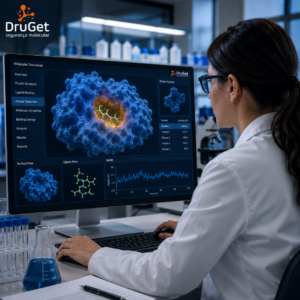
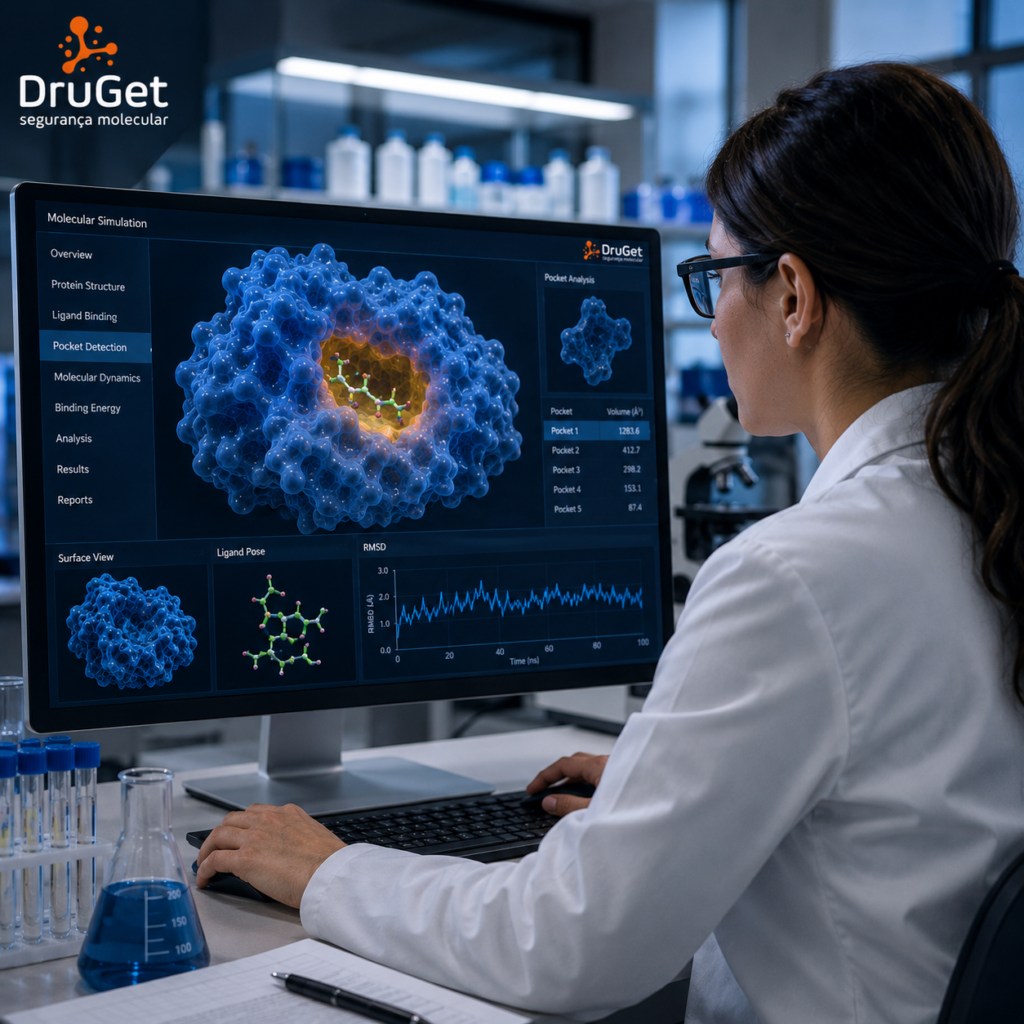
Today, molecular simulation makes it possible to investigate structures and interactions in a virtual environment. In addition, artificial intelligence tools can analyze large volumes of data.
As a result, researchers can prioritize promising hypotheses before moving on to specific experimental studies.
What are molecular targets?
A molecular target is a biological structure that can interact with a molecule and, as a result, produce a specific effect.
Proteins are among the most common examples. Enzymes, receptors, ion channels, and transporters can also act as molecular targets.
For example, consider a protein that is essential for the survival of a pathogenic microorganism. If a molecule blocks an important function of that protein, it may impair the microorganism’s survival or its ability to cause disease.
However, identifying a protein associated with a biological process is not enough.
Researchers must also determine whether that protein represents a promising target for intervention. This is precisely where computational methods can provide valuable support.
How does molecular simulation help target discovery?
Computational methods allow researchers to investigate several characteristics of a biomolecule before performing certain laboratory experiments.
For instance, scientists can analyze its three-dimensional structure and search for regions that may interact with small molecules. In addition, they can investigate how the structure moves over time.
In this way, simulation can help answer important questions.
Does the protein contain a suitable binding region? Does that region remain accessible? Can protein motion reveal new cavities? Can a molecule establish favorable interactions within that site?
These answers alone do not prove that a target will work in practice. Nevertheless, they help researchers select more promising directions for further experiments.
Therefore, computational approaches can serve as powerful tools for scientific prioritization.
Proteins are constantly moving
When we look at the three-dimensional structure of a protein, we may get the impression that its shape is fixed. In reality, proteins are flexible and constantly moving.
This behavior has major implications for drug discovery.
A cavity may remain closed at one moment and become accessible after a structural change. Therefore, analyzing only a static structure can hide important information.
Molecular dynamics helps researchers investigate this behavior.
Through simulations, scientists can follow molecular motions over time. As a result, they can explore different conformations and observe how specific regions behave.
Consequently, this type of analysis may reveal opportunities that a static structure cannot clearly show.
Molecular docking helps explore interactions
Another important computational tool is molecular docking.
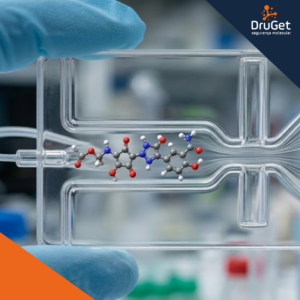
This method explores how different molecules may position themselves within a specific region of a biological structure.
For example, imagine that a protein contains a potentially interesting cavity. Molecular docking can help researchers investigate which molecules may adopt compatible binding modes within that site.
Furthermore, researchers can use this method to compare different candidates.
However, docking represents only one part of the analysis. Scientists need to interpret its results together with structural, physicochemical, and experimental information.
For this reason, combining different methods often leads to stronger hypotheses.
Artificial intelligence expands analytical capabilities
Artificial intelligence has also gained an important role in drug discovery.
Today, algorithms can analyze large biological and chemical datasets. As a result, they may uncover relationships and patterns that would be difficult to identify manually.
For example, these models can process information about proteins, genes, diseases, biological pathways, and chemical compounds.
In addition, artificial intelligence can help prioritize potential targets for more detailed studies.
The combination of AI and molecular simulation creates even greater possibilities.
While AI can identify patterns across large datasets, molecular simulations can investigate specific systems in greater detail.
Therefore, these approaches can complement each other throughout the drug discovery process.
Can simulations reveal hidden targets?
One of the most interesting possibilities involves molecular regions that remain hidden in certain structures.
A protein may initially appear unsuitable for binding small molecules when researchers examine only one conformation. However, its natural movements can reveal temporary cavities.
Researchers often refer to some of these regions as cryptic pockets.
By exploring different protein conformations, molecular simulations can help identify these sites.
Consequently, a protein previously considered difficult to modulate may reveal new opportunities for molecular intervention.
This approach expands the available research space. Instead of investigating only well-known targets and binding sites, scientists can also explore molecular regions that might otherwise remain unnoticed.
From target discovery to the search for new molecules
Computational methods also connect stages of drug discovery that were once more separated.
First, researchers can select a potential target and investigate its structure. Next, they can search for possible binding regions and evaluate candidate molecules.
Virtual screening, for example, allows scientists to evaluate large compound libraries in a computational environment. Therefore, researchers can select a smaller group of promising molecules for subsequent experimental testing.
The process then becomes a cycle.
First, computational models generate hypotheses. Next, researchers test them experimentally. Those experiments produce new data. Finally, scientists can use those data to refine the models and guide new analyses.
Thus, the integration between in silico approaches and laboratory experiments represents one of the major trends in modern drug discovery.
Can simulation replace laboratory experiments?
No.
Computational methods help researchers formulate and prioritize hypotheses, but experimental validation remains essential.
A simulation relies on models and simplifications. Moreover, the quality of its predictions depends on the available data and the methodological choices made during the analysis.
Therefore, a computational prediction does not equal experimental proof.
Even so, simulation can make the research process more focused.
Instead of testing a large number of possibilities without clear prioritization, researchers can concentrate their efforts on hypotheses supported by stronger preliminary evidence.
Thus, computational and experimental approaches are not competitors. They complement each other.
Less trial and error, more data-driven decisions
The chemical space available for discovering new molecules is enormous. At the same time, biological systems offer a vast number of potential targets.
Testing every possible combination in the laboratory would be impractical.
Therefore, computational methods can act as filters.
They help researchers reduce the search space and focus resources on the most promising possibilities.
In addition, these methods can help identify potential problems earlier. Researchers may reconsider a weak hypothesis before investing in more complex experimental stages.
As a result, the main benefit goes beyond speed.
The fundamental change lies in the quality of decision-making throughout the research process.
The future of molecular target discovery will be hybrid
Drug discovery is moving toward greater integration among different scientific fields and technologies.
Bioinformatics, artificial intelligence, molecular modeling, docking, molecular dynamics, and experimental research are already part of this transformation.
In the future, these tools will likely become even more interconnected.
In this scenario, molecular simulation creates a bridge between biological data and experimental decisions. Researchers can first explore possibilities in a virtual environment and then take the most relevant hypotheses to the laboratory for validation.
The goal is not to replace laboratory research.
The goal is to reach the laboratory with better questions.
And when it comes to discovering new drugs, asking the right question can make all the difference.