Pharmacokinetics has always been one of the central pillars of drug discovery and development. Understanding how a compound is absorbed, distributed, metabolized, and eliminated by the body is essential to ensure both therapeutic efficacy and safety.
Traditionally, this evaluation relied on extensive experimental studies and in vivo tests, which required considerable time, financial resources, and often a large number of animal models. However, with the advancement of computational pharmacokinetics, this scenario has begun to change significantly.
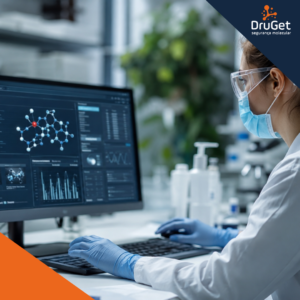
Today, techniques such as machine learning, molecular modeling, and large-scale data analysis allow researchers to predict pharmacokinetic properties during the early stages of research. As a result, scientists can identify promising compounds long before experimental validation takes place.
Moreover, many experts refer to this transformation as the “renaissance of computational pharmacokinetics”, a movement that integrates biology, data science, and artificial intelligence to make drug development more efficient.
From Traditional ADME to Data-Driven Pharmacokinetic Prediction
In traditional drug development, the evaluation of ADME properties (Absorption, Distribution, Metabolism, and Excretion) depended primarily on laboratory experiments and animal studies.
Although these approaches remain essential for scientific validation, they also present important limitations. For example, experimental costs can be high, development timelines are often long, and translation to human biology is not always successful.
On the other hand, advances in computational modeling have opened new possibilities for pharmaceutical research. Today, predictive algorithms can estimate pharmacokinetic properties even before a molecule is synthesized.
Thus, large datasets containing chemical, pharmacological, and clinical information can be analyzed to identify patterns that help predict how new compounds will behave in the human body.
Consequently, pharmacokinetics is no longer only a late-stage experimental step. Instead, it is becoming a strategic tool for early molecular screening.
The Role of Machine Learning in Modern Pharmacokinetics
The application of machine learning in pharmacology has significantly improved the prediction of pharmacokinetic properties. In fact, different algorithms can analyze complex relationships between chemical structure and biological behavior.
Among the most commonly used methods are:
-
Random Forest
-
Gradient Boosting
-
Support Vector Machines
-
Deep Neural Networks
These algorithms are capable of processing thousands of molecular descriptors simultaneously. Additionally, they can identify patterns that would be extremely difficult to detect using traditional statistical approaches.
For example, one of the most important applications is clearance prediction. Machine learning models can estimate drug clearance with greater accuracy, helping researchers predict how long a compound will remain in the body.
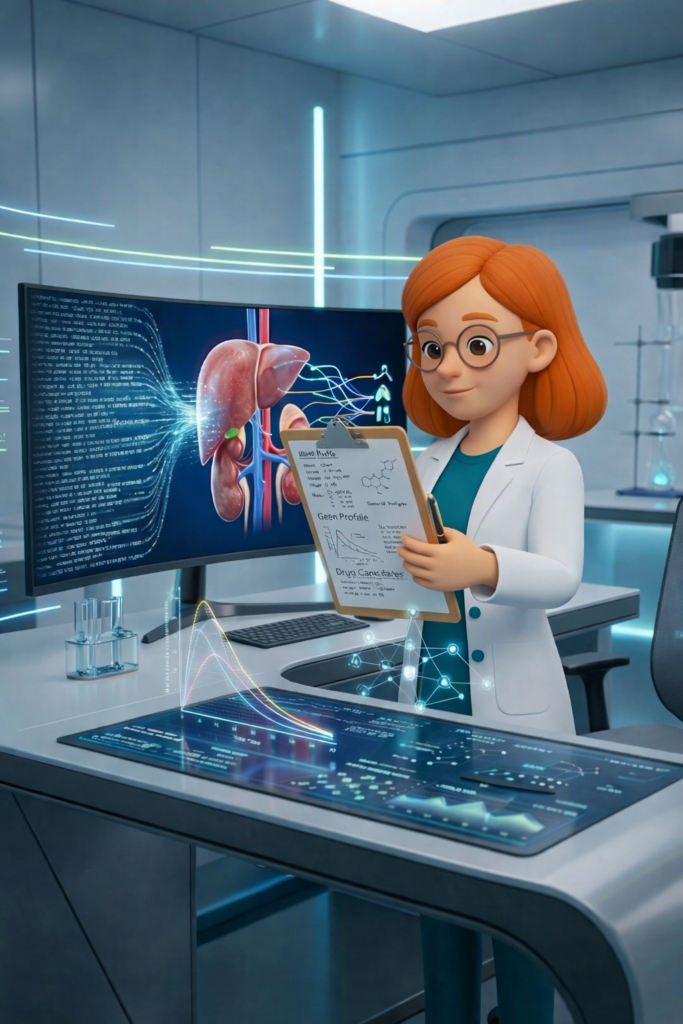
Similarly, deep learning approaches can detect structural patterns associated with toxicological risks, such as liver or kidney toxicity.
Therefore, by integrating structural, pharmacokinetic, and toxicological data, computational models help scientists prioritize molecules with a higher probability of clinical success.
Physics-Informed Neural Networks: Integrating Biology and Artificial Intelligence
Among the emerging approaches in computational pharmacokinetics, Physics-Informed Neural Networks (PINNs) have gained increasing attention.
Unlike conventional artificial intelligence models, PINNs incorporate fundamental equations of physics, chemistry, and physiology into the training process.
In other words, these neural networks are trained not only using experimental data but also using established scientific principles.
As a result, predictions become more consistent with biological reality. Furthermore, this approach helps reduce the well-known “black box” problem associated with artificial intelligence.
Consequently, PINNs represent an important step toward improving scientific and regulatory confidence in computational models applied to pharmacology.
The Impact of Computational Pharmacokinetics on Drug Discovery
The integration of artificial intelligence, molecular modeling, and pharmacokinetics is profoundly transforming the drug discovery process.
First, computational models allow researchers to eliminate unsuitable candidates during the early stages of research. As a result, experimental resources can be focused on compounds with higher therapeutic potential.
In addition, thousands of molecules can be virtually screened before chemical synthesis or laboratory testing.
Another important advantage is the integration of pharmacogenomic data, which contributes to the advancement of precision medicine.
Finally, these approaches also help reduce dependence on animal testing, aligning pharmaceutical development with international guidelines for Next Generation Risk Assessment (NGRA).
The Role of DruGet in Pharmacokinetic and Toxicological Assessment
At DruGet, we use advanced computational methodologies to evaluate pharmacokinetic and toxicological properties of chemical compounds.
Our solutions include:
-
ADME property prediction
-
computational toxicology assessment
-
identification of potential contaminants and impurities
-
computational support for drug discovery
Through the integration of molecular modeling, computational toxicology, and data science, our goal is to reduce costs, accelerate research, and increase safety in the development of new pharmaceutical products.
We believe that the future of pharmacology will be increasingly driven by data, predictive models, and artificial intelligence.
Conclusion
Pharmacokinetics is undergoing a major transformation driven by advances in artificial intelligence and computational modeling.
Today, the use of machine learning for ADME prediction allows researchers to understand how molecules behave in the body more quickly and accurately.
As a result, pharmacokinetics is no longer only an experimental validation step but is becoming a strategic component of early drug discovery.
Ultimately, the integration of biology, data science, and artificial intelligence represents one of the most promising paths toward developing safer, more effective, and more accessible medicines.